Harris Aerial builds American-made heavy-lift drones in Casselberry, Florida. I started the company in 2014 in my grad-school apartment at UCF, with no venture capital and no playbook, because almost nobody was building drones that could carry a real payload. Twelve years later we design, machine and assemble our own airframes, we sell and support hardware instead of competing with our customers, and the compact H4C Quad goes into production at the end of Q1 2027.
Jim Magill told that story for DRONELIFE on October 12. Thanks to Jim and DRONELIFE for taking the time. This post fills in the parts an interview doesn’t have room for.
- 2014Founded in a UCF grad-school apartment, focused on heavy lift
- 2018A gas-electric hybrid launched, and LiDAR flown on the Carrier H4 Hybrid
- Sep 2026The H4C is one of three Pitch the Press winners at Commercial UAV Expo
- Q1 2027First H4C production run, at the end of the quarter
Why build heavy-lift drones in 2014?
Because almost nobody else was. The DJI Phantom 1 had just come out, and most of the industry was building drones that took good pictures. A drone that could lift a real sensor or a real piece of equipment was a gap with almost nobody standing in it, so that is where we went: large frames, heavy payloads.
I’m completely self-taught. That’s an easy thing to say now, when you can ask an AI how to wire a flight controller. In 2014 there was very little on YouTube or anywhere else online about building drones like these. We started on open-source Arduino boards running open-source autopilot software and built our first drones from scratch.
That open-source thread never broke. Every Carrier we ship today flies a Cube Orange+ running our own build of ArduPilot.
There was no venture capital, either. Family and friends backed us at the start, and we bootstrapped the rest.
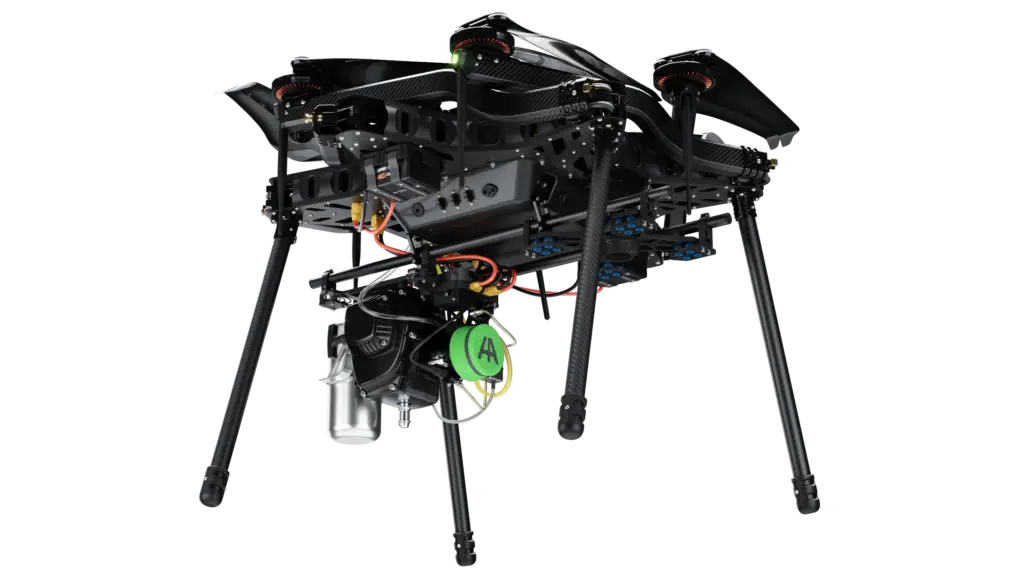
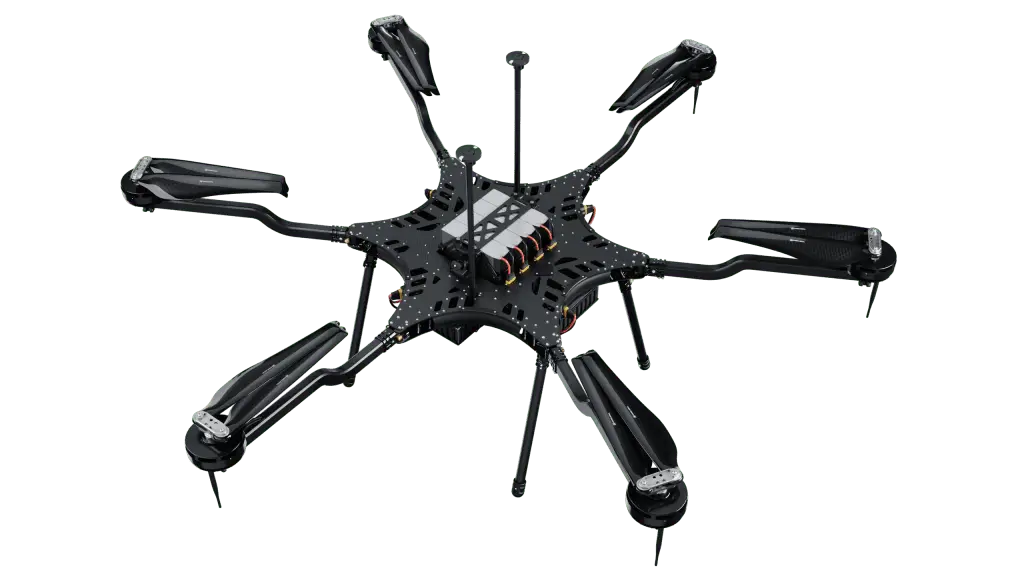
The heavy-lift bet is still the spine of the lineup. Here is the current Carrier range, according to our published specs on the Carrier drones page:
| Platform | Max payload | Max endurance | Built for |
|---|---|---|---|
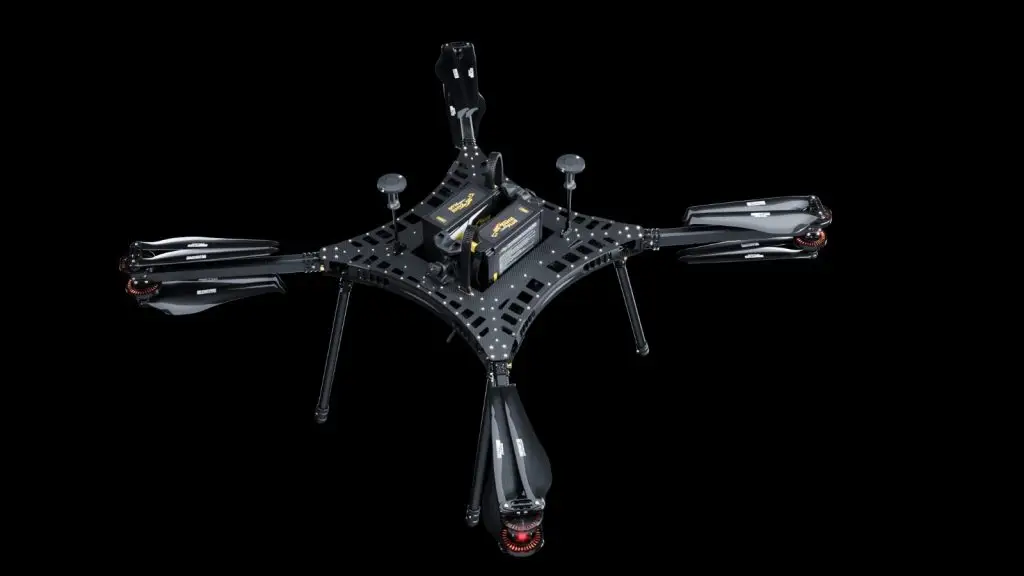
| Carrier H4C Quad | 4 kg (8.8 lbs) | 50 min | Compact, rapid-deploy inspection |
| Carrier H6 Electric | 8 kg (17.6 lbs) | 48 min | General survey, mapping and inspection |
| Carrier H6 Hybrid EFI | 5 kg (11 lbs) | 240 min | Long-duration corridor and pipeline work |
| Carrier HX8 | 8 kg (17.6 lbs) | 43 min | Redundancy-critical, high-value payloads |
| Carrier H6HL | 40 kg (88.2 lbs) | 48 min | Maximum lift |
| Carrier HX8 Tether | 9.5 kg (21 lbs) | Up to 24 hours | Persistent overwatch from a fixed position |
Endurance figures are maximums without payload. Real-world flight time drops as payload goes up.
Why did we stop flying imported airframes?
We didn’t like what we found in them. Early on we prototyped on Chinese-made airframes. We learned a lot from them, mostly about what we didn’t want to fly. So we started designing our own airframes in CAD, and then manufacturing them ourselves, locally, here in the Orlando area.
At the time that decision was about quality and control. In 2026 it’s also about compliance. The NDAA rules on drone components keep evolving and getting stricter. The law targets components and manufacturers from covered foreign countries rather than every non-U.S. company, but in practice the Department of Defense and other federal buyers want a U.S.-based manufacturer. We sell to that market, and making the airframes ourselves is a big part of why we can.
Three of our platforms, the H6 Electric, H6 Hybrid EFI and H6HL, are Blue UAS cleared; our Blue UAS guide to NDAA-compliant heavy-lift drones covers what that means for a buyer. If you’re working through the compliance side of a purchase, our breakdown of NDAA Section 848 drone components is the place to start.
What does “built in-house” mean at Harris Aerial?
It means the parts that decide whether an aircraft is any good get made under our own roof. We 3D print for prototyping. We run our own CNC mills and machine our aluminum, brass and stainless parts in-house. We also cut the molds and plates we use to press and cure carbon fiber into finished parts.

When we want to try something, we make it, fly it and validate it without waiting in a third-party fabricator’s queue. That’s what American-made means for us: our team designs the airframe, and the parts get cut and molded in our own shop.
Why doesn’t Harris Aerial sell drone services?
Our customers sell services, and we’re not going to compete with them. We’re a manufacturer at our core. A lot of the people who buy our aircraft put them to work on survey, inspection and mapping contracts. If we started flying those jobs ourselves, we’d be bidding against the same people who trust us with their fleets.
So we decided a long time ago to sell hardware and support the hardware we sell. What we offer beyond the aircraft is training, consulting and custom engineering. We have base models, but a big part of our work is sensor integration. Research labs come to us with a sensor they’re still developing, and we engineer it onto our platform. Every Carrier shares the same quick-release payload connector, so an integrated payload isn’t locked to a single airframe, within each platform’s payload limit.
If you run a service business or sell drones yourself, that’s the short answer to where we stand: we’re your supplier, not your competition.
Where does the H4C fit?
The H4C is our compact, medium-lift platform: a small footprint with the lift our larger aircraft are known for. It carries up to 4 kg, flies up to 50 minutes unloaded and about 24 minutes at the full 4 kg, and folds small enough for one person to carry in a hard case. The first production run is scheduled for the end of Q1 2027.

When Jim asked how it stacks up, I told him its “payload capability of four kilograms is unmatched right now in the U.S. market,” and that its flight time comes in at nearly three times the Freefly Astro’s.
I expect the H4C to sell in higher volume than our larger platforms. Its size and form factor open it up to a lot more teams. It was one of three Pitch the Press winners at Commercial UAV Expo in September, and pre-orders are open now. If you’re deciding between a quad and a hex, we wrote up when a 4 kg quad is the right tool.
What this means if you’re buying
- You’re buying from the people who designed and machine the aircraft, so support questions go to the team that built it.
- We won’t show up as a competitor on your next service bid.
- If your sensor isn’t on our payload list, ask anyway. Custom integration is a big part of what we do.
- If compliance decides the purchase, we design and build the airframes ourselves, so sourcing questions get straight answers.
None of this happens without the family and friends who backed Harris Aerial at the start, the customers who keep bringing us problems worth solving, and the team in Casselberry who builds every aircraft we ship. Thank you.
Questions people ask about Harris Aerial
Who founded Harris Aerial, and when?
Ben Harris founded Harris Aerial in 2014, while he was a graduate student at the University of Central Florida. He started the company in his grad-school apartment, taught himself to design and build drones, and funded it with help from family and friends instead of venture capital.
Where are Harris Aerial drones made?
Harris Aerial designs and manufactures its airframes in Casselberry, Florida, in the Orlando area, and assembles and supports its aircraft there. Prototyping, CNC machining of aluminum, brass and stainless parts, and carbon fiber molding all happen in-house.
Does Harris Aerial offer drone services?
No. Harris Aerial is a manufacturer only. It sells aircraft, training, consulting and custom engineering, and supports the hardware it sells, but it does not fly service contracts that belong to its customers.
Can Harris Aerial integrate my sensor?
Yes. Every Carrier platform uses the same quick-release payload connector, and the engineering team integrates customer and research sensors, including sensors that are still in development. The integrations page shows recent work.
Which Harris Aerial drones are Blue UAS cleared?
The Carrier H6 Electric, Carrier H6 Hybrid EFI and Carrier H6HL are Blue UAS cleared. For federal or defense work, ask us for the component declaration on your exact configuration, payload included.
Why does Harris Aerial build its own airframes instead of buying them?
Early prototypes on Chinese-made airframes showed the company problems it didn’t want to fly with, so Harris Aerial moved to designing airframes in CAD and manufacturing them itself in Florida. That started as a quality and control decision; today it also keeps the supply chain clear for federal and defense buyers.
Featured in: “Finding a Niche in American Drone Manufacturing: The Harris Aerial Story,” by Jim Magill, DRONELIFE, October 12, 2026.