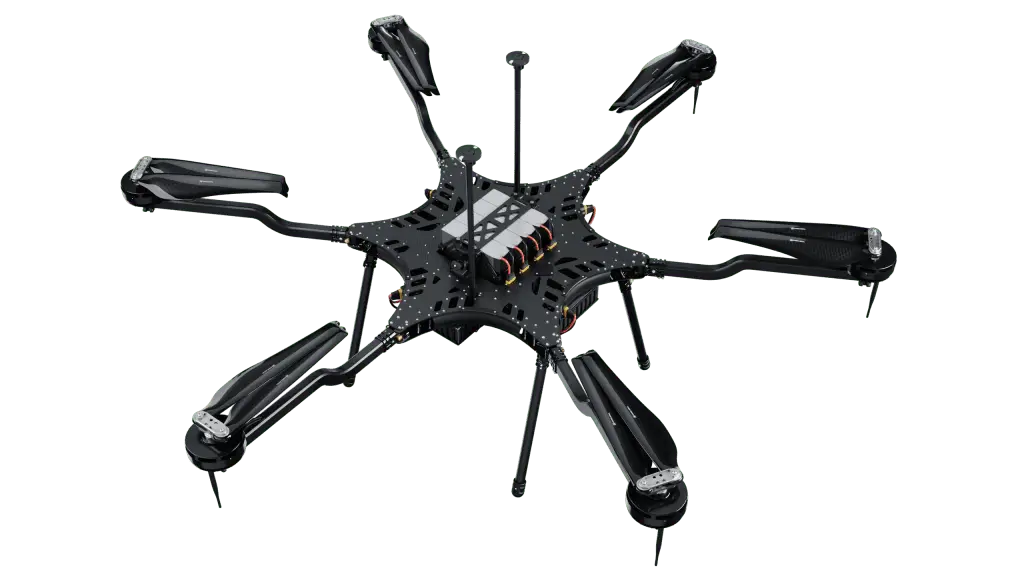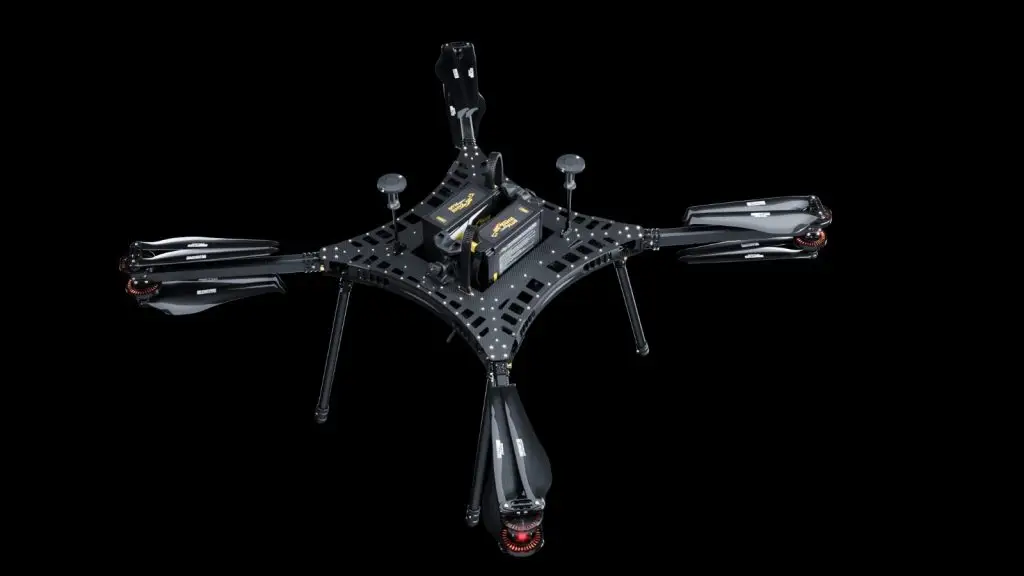
A heavy-lift quadcopter is the right tool when your payload weighs 4 kg or less and you care more about setup speed and portability than about surviving a motor failure. Our Carrier H4C Quad, now taking pre-orders for its first production run at the end of Q1 2027, is rated for up to 4 kg (8.8 lb) of payload and up to 50 minutes of flight with no payload (about 24 minutes at a full 4 kg), and folds to 414 × 380 × 238 mm so one person can carry it to the launch point. When the sensor is heavier than that, or the mission needs motor-out tolerance over people or infrastructure, a hexacopter such as the Carrier H6 Electric is the better aircraft.
| Carrier H4C Quad | Carrier H6 Electric | |
|---|---|---|
| Frame | Foldable quadcopter, 4 motors | Hexacopter, 6 motors |
| Max payload | 4 kg (8.8 lb) | 8 kg (17.6 lb) |
| Max flight time | 50 min with no payload, about 24 min at 4 kg | Up to 48 min unloaded |
| Empty weight | 8.15 kg (18 lb) | 18.1 kg (40 lb) |
| Batteries | 2 × 8,000 mAh 12S HV LiPo | 2 × 12S 16,000 mAh LiPo |
| Folded size | 414 × 380 × 238 mm (16.3 × 15 × 9.4 in) | Larger airframe and case |
| Availability | Pre-order from $24,999 (base package); first production run end of Q1 2027 | Available to order |
What makes a quadcopter “heavy-lift”?
There is no regulatory definition. In practice the term means an aircraft built around a working payload measured in kilograms rather than grams: a LiDAR unit, a multispectral camera, a gimballed EO/IR sensor, or a delivery box. Most consumer and prosumer quads carry their own camera and little else. Many aircraft sold as heavy-lift are hexacopters or octocopters, because more motors means more thrust and more margin.
A heavy-lift quad sits in the space between those two groups. The H4C has a 12.15 kg (26.8 lb) maximum takeoff weight, which keeps it well under the 55 lb line that separates routine Part 107 operations from aircraft that need extra FAA paperwork. It still delivers 48 V, 24/28 V, 12/14 V and 5 V payload power, so it can run the same class of survey sensors our larger frames carry.
Quad or hexacopter: the trade you’re actually making
A quad gives up one thing to a hexacopter: tolerance for a dead motor. Most of the rest is a trade between payload and portability.
- Redundancy. A quadcopter has no spare motor. If one fails, the aircraft can’t hold attitude. A hexacopter can often get down under control after losing a motor, depending on its load. The H4C does carry redundancy where it can: two batteries run in parallel and the flight controller (Cube Orange+ running our custom ArduPilot) has triple-redundant IMUs. Propulsion is the one place a quad can’t duplicate.
- Payload. Our hexacopter doubles the payload ceiling to 8 kg. If your sensor and mount come in near 4 kg on paper, size up. Mounts and cables add weight that the spec sheet for the sensor alone doesn’t show.
- Logistics. The H4C weighs 8.15 kg empty, less than half of the H6 Electric. That is the difference between one person carrying the aircraft down a right-of-way and needing a vehicle at the takeoff point.
If your operation flies over crews, roads or energized equipment and your safety case leans on motor-out tolerance, take the hexacopter. If the job is a fast, repeatable survey where the aircraft has to travel and set up quickly, the quad earns its place.
What 4 kg actually carries
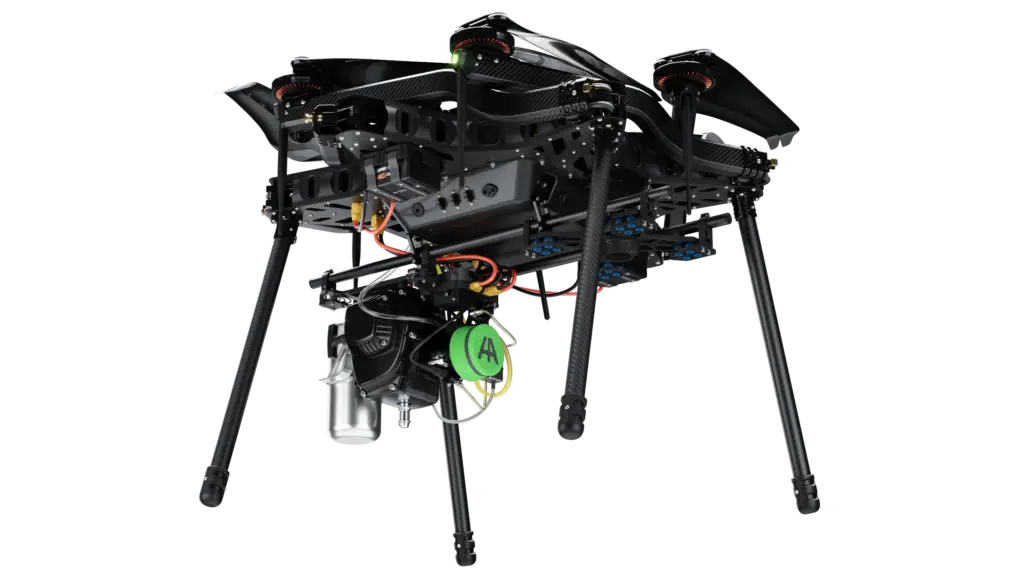
Four kilograms covers more sensors than most buyers expect. Compact survey LiDAR, multispectral and hyperspectral cameras, and many gimballed thermal and zoom cameras fall inside it. Our compact-class LiDAR demo for TopoDOT 2026 shows the H4C flying a Phoenix LiDAR RANGER-U120, and you can watch it on our integrations and demos page.
The figure that matters for planning is flight time at your real payload weight, not the headline number. The H4C is rated for 50 minutes empty and about 24 minutes carrying 4 kg. A lighter sensor lands somewhere between. Before you commit to a mission plan, send us the exact sensor and mount you intend to fly. We confirm weight, power draw and mounting for that payload, and the full list of supported sensors is on our payloads page.
Setup, transport and the field day
Unfolded, the H4C measures 1,510 mm prop tip to prop tip. Folded, it drops to 414 × 380 × 238 mm, small enough for the back seat of a pickup. It flies on dual RTK GNSS, is rated for operational winds up to 30 mph (13 m/s), operates from −20 °C to 49 °C, and has a command link range of up to 15 km for operations approved beyond visual line of sight. Its ingress rating is listed as IP54 (expected).
For crews moving between several small sites in one day, that combination is the point of the aircraft. Less unpacking, one battery pair per sortie, and an airframe one person can carry.
When to skip the quad
- Your payload is over 4 kg, or close enough that mounts push it over. Look at the Carrier hexacopter and octocopter line.
- You need more than about 25 minutes at full payload. Long corridors and large areas favor our gas-electric Carrier H6 Hybrid EFI, rated for up to 240 minutes.
- Your safety case requires motor-out tolerance. Six or eight motors buy that margin. Four cannot.
- Federal buyers should read our guide to NDAA-compliant heavy-lift drones before choosing any platform.
Where the H4C stands today
The H4C is listed as NDAA compliant and made in the USA, and for federal or defense work you should still ask for the component declaration on your exact configuration, payload included. Limited first-run production is scheduled for the end of Q1 2027, and we are taking reservations now. The base package, a ready-to-fly airframe with two batteries, charger and transport case, starts at $24,999; ground control, payload integration and training are quoted separately. If you want an aircraft from that first run, tell us how many units you need and what you plan to fly through the H4C reservation form. The full specifications and brochure are on the H4C Quad page.
Frequently asked questions
How much weight can a heavy-lift quadcopter carry?
It depends on the frame. The Carrier H4C Quad is rated for a 4 kg (8.8 lb) maximum payload. Quads built for heavier loads exist, but past a few kilograms many manufacturers move to six or eight motors for thrust margin and redundancy.
Is a quadcopter safe for carrying expensive sensors?
It can be, if you accept that one failed motor means a forced landing. If the sensor is worth more than the aircraft, or you fly over people and infrastructure, a hexacopter is the safer choice. Parallel batteries and triple-redundant IMUs reduce the H4C’s other single points of failure.
How long does the H4C fly with a payload?
About 24 minutes with a full 4 kg payload and up to 50 minutes with no payload. Lighter sensors fall between those two figures.
When can I get an H4C Quad?
Limited first-run production is scheduled for the end of Q1 2027. Reservations are open now through the form on the H4C page, and the base package starts at $24,999.
Does the H4C need a special FAA certificate?
Its 12.15 kg (26.8 lb) maximum takeoff weight is under the 55 lb Part 107 limit, so standard Part 107 rules apply: the pilot needs a Part 107 remote pilot certificate and the aircraft must be registered. Flights beyond visual line of sight still need FAA authorization.