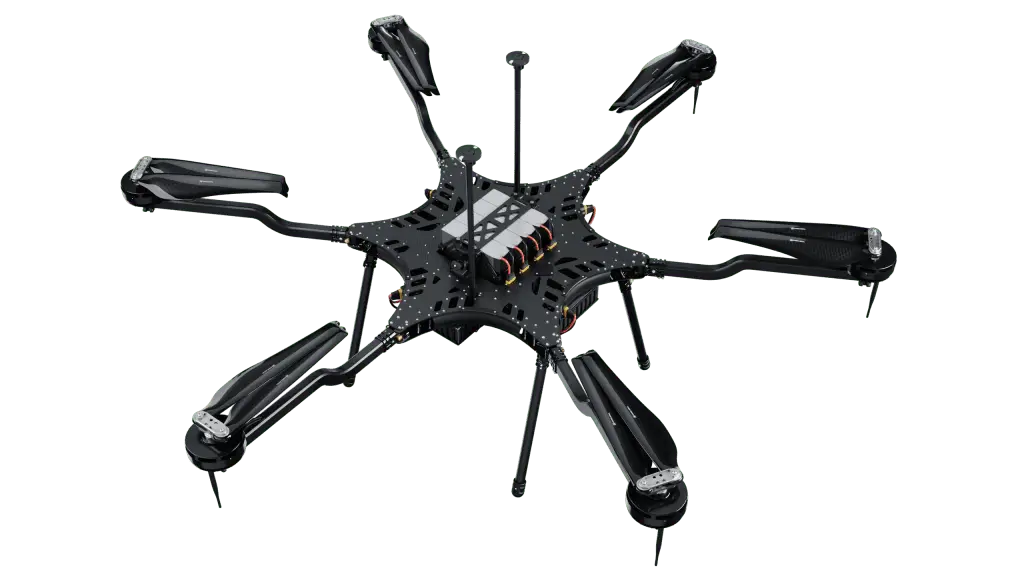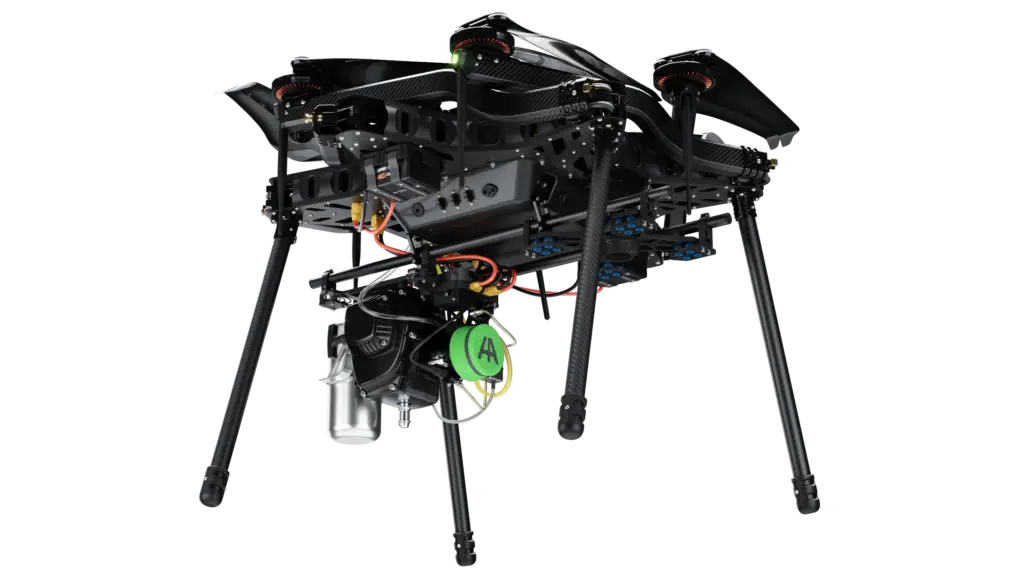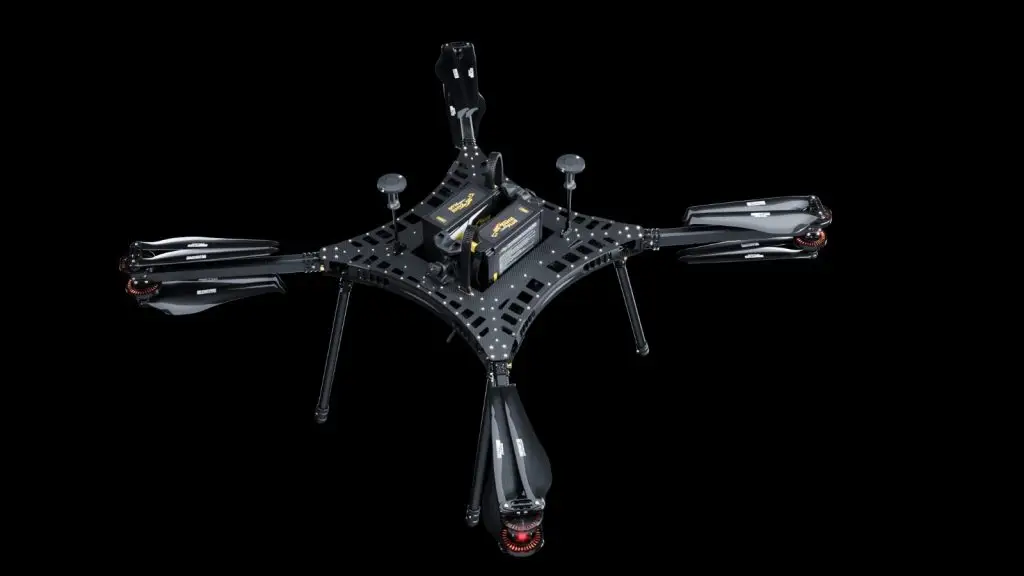
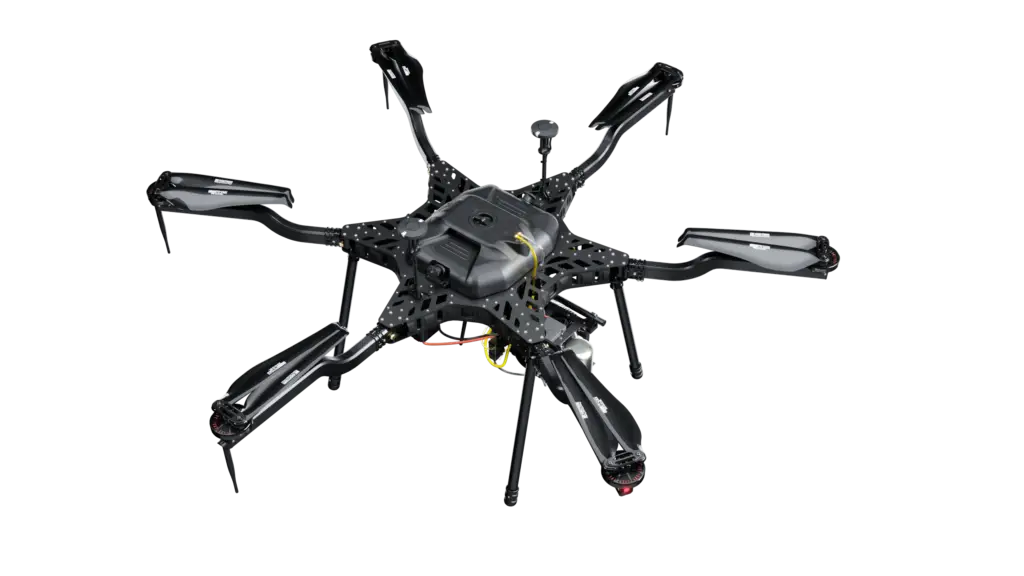
Up to four hours on one tank. We rate the Carrier H6 Hybrid EFI for as long as 240 minutes of flight, against 48 minutes for the same airframe running on batteries as the H6 Electric. The difference isn’t a bigger battery. It’s an onboard 2.4 kW fuel-injected generator that makes electricity in flight, so the aircraft carries its energy as liquid fuel instead of lithium.
| Carrier H6 Electric | Carrier H6 Hybrid EFI | |
|---|---|---|
| Power source | Two 12S 16,000 mAh LiPo packs | H2400 EFI generator, 2.4 kW continuous, with a 6S LiPo buffer |
| Max flight time | Up to 48 min (unloaded) | Up to 240 min |
| Max payload | 8 kg (17.6 lb) | 5 kg (11 lb), 7 kg rating coming |
| Turnaround | Battery rack swap | Refuel, about the time of a battery swap |
| Blue UAS list | Yes (June 2026) | Yes (June 2026) |
Why battery drones cap out around an hour
A multirotor spends most of its power just staying in the air. Every kilogram you add costs more hover power, and battery energy is heavy relative to what it stores, so past a point adding cells buys almost no extra time. That’s why a heavy-lift electric hexacopter like the H6 Electric tops out around 48 minutes unloaded on our spec sheet, and why real missions with a sensor attached run shorter than the brochure number on any battery drone, ours included.
Gasoline stores far more energy per kilogram than a lithium pack. A hybrid trades a few kilograms of engine, generator and fuel for hours of run time, and the fuel load gets lighter as the flight goes on. The airframe keeps its electric motors, so the aircraft handles the same way for the pilot and the flight controller. Only the power source changes.
How a gas-electric hybrid drone actually works
The H6 Hybrid EFI carries an H2400 electronic-fuel-injected generator that produces 2.4 kW of continuous power for the motors. A small backup battery, a 6S LiPo pack, sits in the loop as a buffer. It absorbs momentary peaks when the aircraft needs a burst of power, and it gives the pilot reserve time to land if the engine were ever to stop. The battery isn’t there to extend endurance. The fuel is.
Electronic fuel injection matters more than it sounds. Carbureted small engines drift with temperature, altitude and humidity and need retuning in the field. EFI meters fuel electronically, so starts are consistent and power output holds steady from a cold morning at sea level to a hot afternoon at elevation. In practice that means less time troubleshooting an engine and more time flying, and refuelling takes about as long as swapping a battery pack.
The payload versus endurance trade
Every endurance number has a payload attached to it, and honest spec sheets say so. Load the H6 Hybrid EFI to the top of its 25 kg takeoff envelope and flight time comes down from the 240-minute figure; fly it light with a compact camera and you sit near the top of the range. The way we’d size it:
- Heavier sensor, shorter and repeatable flights near the truck: the H6 Electric, which lifts more but flies for well under an hour.
- Long corridors, wide survey blocks, long transits: the hybrid drone, anywhere we’d otherwise be stopping to swap packs before the hour is up.
- Not sure: tell us the sensor and the distance, and we’ll come back with a configuration and a real flight-time estimate rather than a headline number.
Where four hours changes the mission
Corridor work is the obvious case. Transmission-line, pipeline and rail inspection is linear, so endurance converts directly into miles covered per launch point and fewer road moves for the crew; we wrote up how utilities weigh this in our powerline inspection guide. Large-area LiDAR and photogrammetry blocks are the next case, where one long flight avoids the seams and re-flights that come with stitching a dozen battery sorties together. Then there is anything with a long transit to the work area, such as the coastal and forestry survey work our customers fly, where a battery aircraft spends its energy getting there.
The longest flight we’ve published on this platform is a 77-mile non-stop demonstration, flown on the H2400 EFI generator over real terrain. The video is on the platform page.
We’ve been building hybrids since 2018
Harris Aerial’s first gas-electric aircraft, the Carrier H4 Hybrid, flew for more than two hours with a roughly 10-pound payload when we launched it in Orlando in 2018. The H6 Hybrid EFI is where that work landed: electronic fuel injection, a folding airframe, and the same quick-release payload mount and 19-pin universal payload connector used across the Carrier line. It’s also on the Blue UAS list alongside the H6 Electric and H6HL, which matters if your program answers to federal funding. If compliance is new territory for your team, start with our NDAA and Blue UAS guide.
Frequently asked questions
How long can a hybrid drone fly?
Gas-electric multirotors fly for hours rather than minutes. We rate the Carrier H6 Hybrid EFI for up to 240 minutes, with actual time depending on payload weight, wind and flight profile.
What is the difference between a hybrid drone and an electric drone?
Both use electric motors. An electric drone draws from lithium batteries, which are heavy for the energy they hold, so flights typically last under an hour. A hybrid runs a small fuel-injected engine that drives a generator, powering the motors in flight while a small battery buffers peaks and provides an emergency reserve.
Does a hybrid drone still need a battery?
Yes, but a small one. On the H6 Hybrid EFI a 6S LiPo pack smooths power demand and gives the pilot reserve to land safely if the generator stops. It doesn’t set the endurance; the fuel does.
Is a hybrid drone NDAA compliant?
Ours is. The Carrier H6 Hybrid EFI is built in Casselberry, Florida, is NDAA compliant, and was added to the Blue UAS list in June 2026 together with the H6 Electric and H6HL.
Sizing a long-endurance mission? Talk to our team, or see the Carrier H6 Hybrid EFI platform page for the full spec sheet and the demonstration flight.