“NDAA-compliant” and “Blue UAS cleared” are not the same thing, and treating them as if they are can disqualify your aircraft from a federal job. NDAA compliance is a legal condition: no critical components from covered foreign entities under Section 848 of the FY2020 NDAA. Blue UAS is a Defense Innovation Unit (DIU) program that vets and lists the aircraft the government has already cleared to buy and fly. Every Blue UAS drone is NDAA-compliant; not every NDAA-compliant drone is on the Blue list. For heavy-lift work — 25 kg and up of payload — the pool that clears both bars is small, and in 2026 it changed.
Most compliance guides are written for someone shopping for a mapping quadcopter that fits in a backpack. This one is for the operator who has to lift a LiDAR array, a multispectral gimbal, a cargo box, or a sensor mast — and still hand a procurement officer a clean answer. I build those aircraft in Florida, so I’ll tell you where the real lines are, where buyers get burned, and how to verify a compliance claim instead of trusting a spec sheet.
What does NDAA-compliant mean for a drone?
NDAA-compliant means the aircraft contains no critical components produced by a “covered foreign entity,” as defined by Section 848 of the National Defense Authorization Act for Fiscal Year 2020. In plain terms, the flight controller, the ground-control software, the radios, and increasingly the flight batteries cannot come from a short list of specified manufacturers. DIU publishes component-definition guidance under Sec 848 that spells out which parts are in scope, and it is stricter than most buyers expect: a compliant airframe with a non-compliant data link is still a non-compliant system.
The reason this matters got sharper after 2023. The American Security Drone Act, passed as part of the FY2024 NDAA, bars federal departments and agencies from procuring or operating covered UAS, and the Federal Acquisition Regulation rule implementing that prohibition took effect in late 2024. State programs that spend federal grant dollars — public safety, agriculture, transportation — increasingly inherit the same restriction. “NDAA-compliant” stopped being a nice-to-have and became a gate you either clear or you don’t.
What is the Blue UAS Cleared List?
The Blue UAS Cleared List is a vetted roster of commercial drones that DIU has already validated as NDAA-compliant and cyber-approved for U.S. government use. Being on the list means a federal buyer can procure the aircraft without running its own component teardown or authority-to-operate process from scratch — the vetting is done. That shortcut is the whole value: it collapses months of procurement diligence into “pick from this list.”
Harris Aerial was officially added to the Blue UAS Cleared List on June 22, 2026, which is the reason we’re writing this now. In the same window, one of the better-known larger platforms — the Freefly Alta X — moved off Blue status as Freefly transitioned toward the commercial AUVSI Green UAS path. If you built a program around a specific aircraft’s Blue status a year ago, that status is not permanent — re-check it before your next buy.
Blue UAS vs Green UAS vs NDAA-compliant: which do you actually need?
Which label you need depends entirely on who signs the check. If the money is federal and the operator is a government agency, you almost always need Blue UAS. Defense units and their contractors can start with our military heavy-lift drone overview. If you’re a commercial contractor who wants a credible third-party compliance signal without the DIU listing, AUVSI’s Green UAS certification is built for you. If you’re buying with private dollars and only need to avoid the covered-entity supply chain, plain NDAA compliance may be enough — but you carry the burden of proving it.
| Blue UAS | Green UAS | NDAA-compliant (self-declared) | |
|---|---|---|---|
| Who issues it | DIU (U.S. government) | AUVSI (industry association) | The manufacturer |
| What it proves | Government-vetted, cleared to buy & fly | Third-party certified to the NDAA standard | A supply-chain claim, until verified |
| Who typically needs it | Federal agencies; federally funded programs | Enterprise & public-safety buyers | Private commercial buyers |
| Where to verify | Current dated DIU cleared list | AUVSI Green UAS registry | Component bill of materials |
| Heavy-lift options | Few — mostly small ISR/mapping | Growing, still limited | Varies; verify per model |
Why heavy-lift makes compliance harder
Heavy-lift compounds the compliance problem because the components hardest to source domestically are exactly the ones a big aircraft needs most. A 2 kg mapping drone can run a small, commodity flight stack. A platform carrying 20 to 40 kg needs high-current motor controllers, large flight batteries or an onboard generator, redundant autopilots, and a robust data link — and for years the densest versions of those parts came from the same overseas suppliers the NDAA now excludes. That is why the Blue list skews toward small ISR and mapping aircraft, and why compliant heavy-lift options are comparatively rare.
This is the gap nobody writing these guides addresses. Search “NDAA-compliant drone” and you’ll get ten articles comparing sub-25 kg quadcopters. Almost none help the person who has to fly a hydrogen fuel cell endurance mission, spray a field, or carry a survey-grade sensor package and still hand a procurement officer a clean compliance answer. The heavy-lift buyer has fewer choices and higher stakes, and deserves a straight answer.
How Harris Aerial’s Carrier line fits
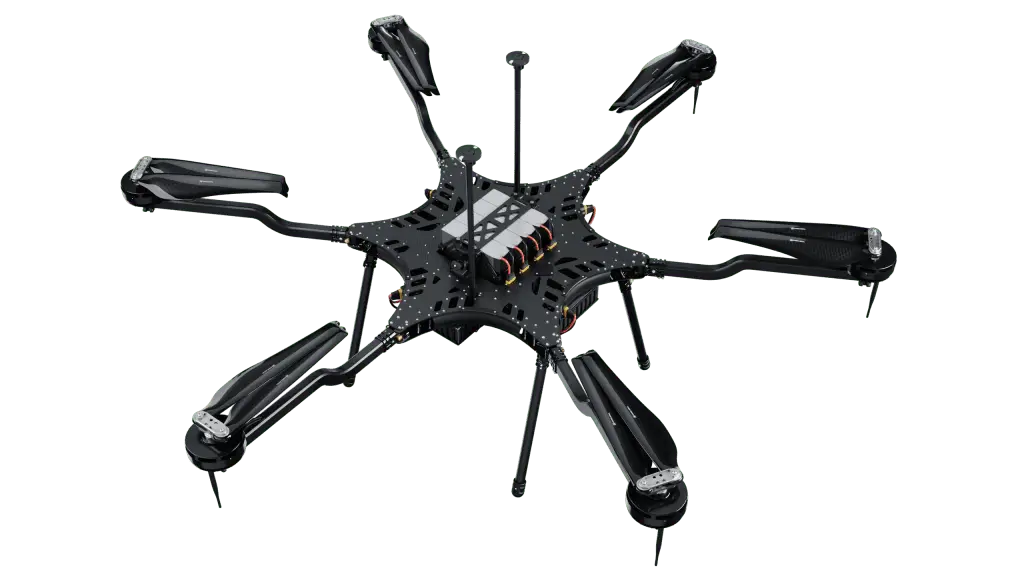
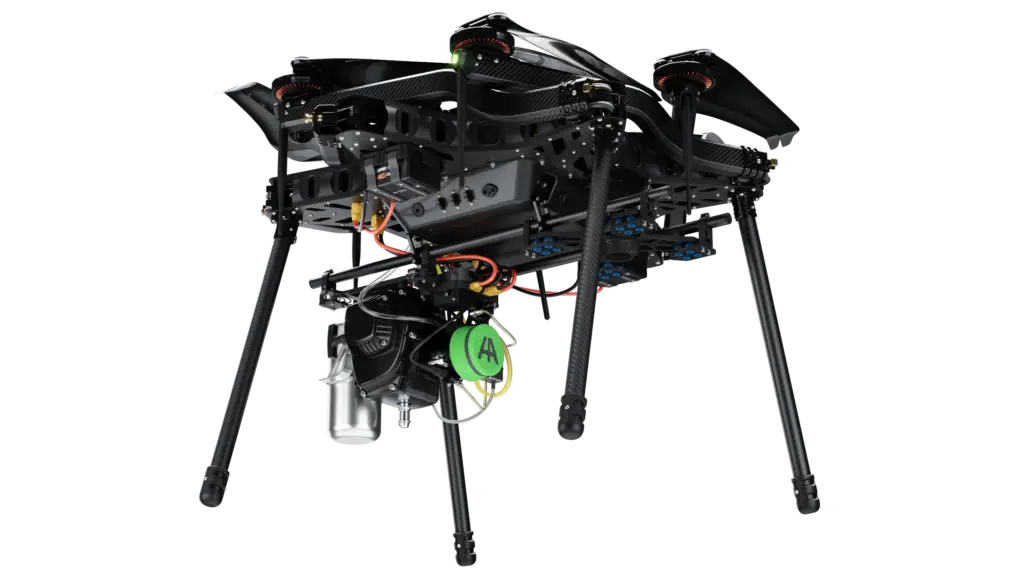
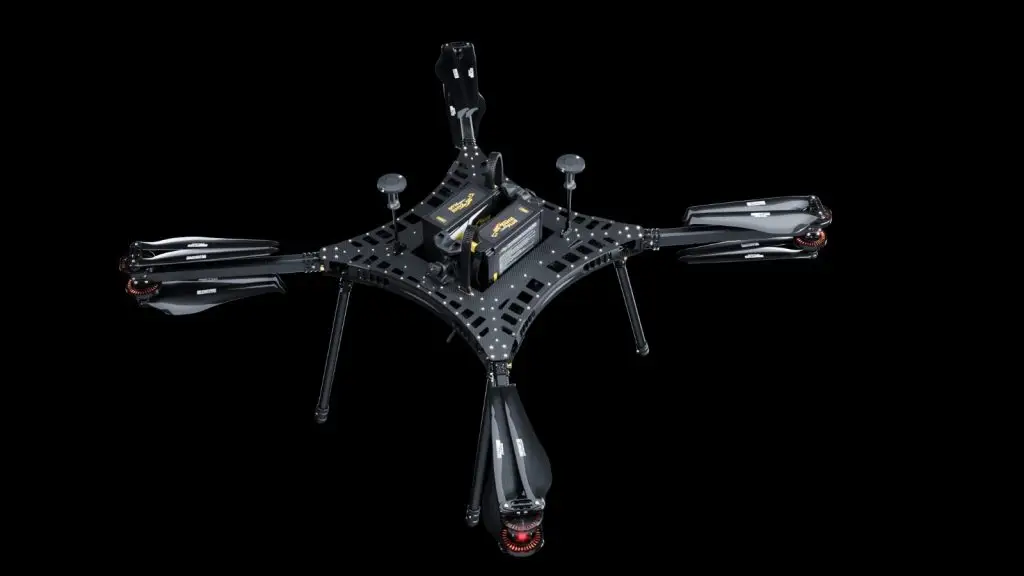
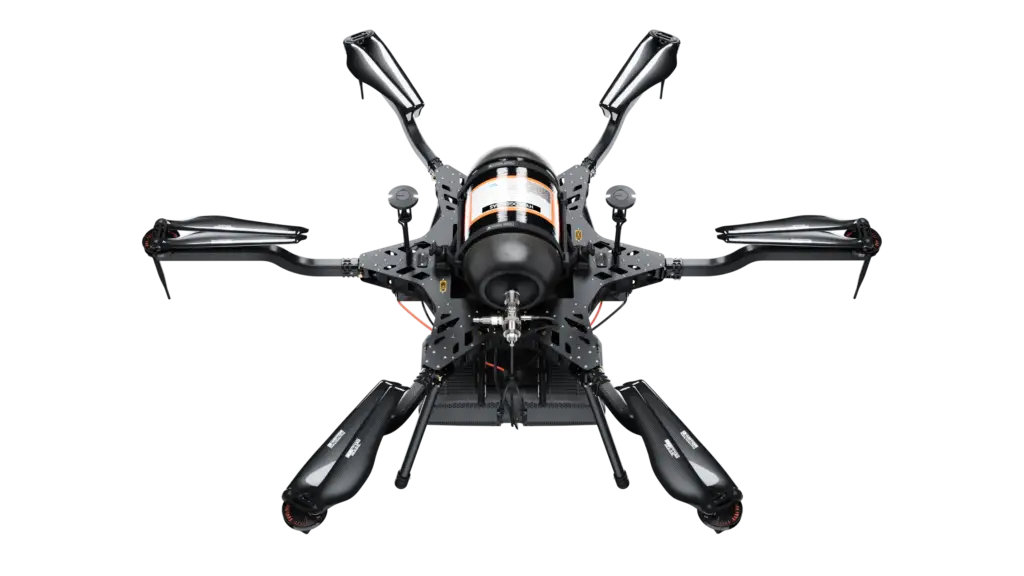
Our Carrier line is a family of American-made heavy-lift platforms designed from the airframe out to clear the compliance bar rather than retrofit for it. The lineup spans an all-electric heavy-lift hexacopter, the 40 kg-class Carrier H6HL, a gas-electric hybrid drone built for multi-hour endurance, and the Carrier H6 Hydrone, which uses a hydrogen fuel cell for long-duration flight. Each targets a different point on the payload-versus-endurance curve, and each is built and supported in Casselberry, Florida.
I’m not going to print payload and endurance numbers in a blog post and ask you to trust them — configurations change, and you should verify against the live spec page for your mission. The point is the category: if your work needs real lifting capacity and a compliance answer that survives an audit, you’re choosing from a short list, and a purpose-built American heavy-lift platform belongs on it. Exact figures for each model live on the Carrier platform pages, and our support center documents the payload-integration details.
How to verify a compliance claim before you buy
Verify compliance at the component level, not the marketing level. Ask for the specific answer, in writing, on four parts:
1. Is the exact model and configuration on the current, dated DIU Blue UAS Cleared List? 2. Who makes the flight controller and the ground-control software? 3. What’s in the data link and the radios? 4. Where are the flight batteries sourced? A vendor who answers those four crisply is telling the truth; one who says “yes, it’s NDAA-compliant” and changes the subject is not.
Two traps catch buyers repeatedly. The first is the compliant-airframe / non-compliant-payload trap: the drone is clean, but the third-party sensor or radio you bolt on is not, and the assembled system fails. The second is the stale-status trap — a “Blue UAS” claim that was true last year and quietly isn’t anymore. Both are avoidable with a five-minute check against the primary source before the purchase order goes out.
Key takeaways
- Blue UAS and NDAA-compliant are not synonyms. Blue UAS is DIU’s vetted list; NDAA compliance is the underlying legal supply-chain standard, and Blue is the stricter, narrower proof.
- Compliance is now a federal gate. The American Security Drone Act plus the 2024 FAR rule turned it from optional into a procurement requirement.
- Heavy-lift makes it harder. The biggest, densest components are the hardest to source domestically, so the compliant heavy-lift pool is small.
- Status is not permanent. Harris Aerial joined the Blue list on June 22, 2026, while the Freefly Alta X moved off it in the same window.
- Verify at the component level — model, flight controller, ground software, data link, batteries — against the live DIU list before you buy.
Frequently asked questions
Is a DJI drone NDAA-compliant?
No. DJI is treated as a covered entity under the NDAA framework, which is why federal agencies are restricted from procuring or operating its aircraft and why “DJI alternative” and “NDAA-compliant” have become near-synonyms in enterprise buying. If you’re moving off DJI for a government-adjacent program, you’re looking for Blue UAS or Green UAS, not just any American-branded drone.
Does Blue UAS mean the same thing as NDAA-compliant?
Not exactly — every Blue UAS aircraft is NDAA-compliant, but not every NDAA-compliant aircraft is on the Blue list. Blue UAS is DIU’s specific, vetted government-cleared roster; NDAA compliance is the broader legal standard the Blue vetting is built on.
Do I need a Blue UAS drone or is NDAA-compliant enough?
It depends on who’s paying and who’s flying — federal agencies almost always need Blue UAS, federally funded state and local programs increasingly do too, and purely private commercial buyers may only need documented NDAA compliance or a Green UAS certification. Match the label to the strictest requirement in your funding chain.
Are there NDAA-compliant heavy-lift drones?
Yes, but the list is short. Most NDAA-compliant and Blue UAS aircraft are small ISR or mapping platforms, and heavy-lift options that carry 25 kg or more while clearing the same supply-chain bar are comparatively rare — which is exactly the niche the American-made Carrier line was built for.
What is the difference between Blue UAS and Green UAS?
Blue UAS is a government program run by DIU that lists drones cleared for federal use, while Green UAS is a commercial certification from AUVSI, aligned to the same NDAA supply-chain standard, aimed at enterprise and public-safety buyers who want third-party proof without the federal listing. Some manufacturers pursue Green as a path toward or alongside Blue.
How do I verify a drone is really NDAA-compliant?
Check the exact model and configuration against the current, dated DIU Blue UAS Cleared List, then ask the manufacturer in writing who makes the flight controller, ground-control software, data link, and batteries. Compliance lives at the component level, so a real answer names parts and sources rather than repeating the word “compliant.”
Does a hydrogen fuel cell drone change the compliance picture?
Not the legal standard, but it changes the sourcing challenge — a hydrogen fuel cell platform still has to prove its flight controller, software, and radios are clean, and the fuel cell and its balance-of-plant add components a buyer should confirm are domestically sourced. The compliance questions are the same four; there are just a few more parts to answer for.
Ben Harris is the founder of Harris Aerial, a manufacturer of American-made heavy-lift and long-endurance UAV platforms — including the Carrier line used in utility inspection, agriculture, surveying, and public-safety work. He works directly with enterprise and government operators on payload integration and compliance for demanding missions.
See the full Carrier platform lineup for current payload and endurance specs, or talk to our team about matching an American-made airframe to your compliance requirements.