Three Harris Aerial platforms are on the Blue UAS Cleared List: the Carrier H6 Electric, the Carrier H6 Hybrid EFI and the Carrier H6HL. Each one is engineered in Casselberry, Florida, built in-house in the United States, flies a Cube Orange+ running our own ArduPilot build, and is quoted to defense and federal buyers in its Blue UAS configuration. Between them they cover 5 to 40 kg of payload and 48 to 240 minutes of flight.
Blue UAS is the Department of Defense program that vets commercial drones for military use. The Defense Innovation Unit (DIU) started it, and the Cleared List is now administered through the Defense Contract Management Agency (DCMA). An aircraft on the Blue UAS Cleared List has been evaluated for NDAA compliance and cybersecurity, and DoD units can buy and fly it without filing an exception to policy.
The list is specific. It names a manufacturer and a model, which is why we quote defense and federal buyers the Blue UAS configuration instead of the commercial build. Commercial orders ship NDAA-compliant; the cleared build is what goes on a DoD or federal purchase order. Two lists carry the Blue UAS name: the Cleared List covers complete aircraft, and the Blue UAS Framework covers components such as flight controllers, radios and sensors that integrators build with. Our three platforms are on the Cleared List.
Outside the Department, federal civilian agencies and a number of state procurement rules reference the same list, and public-safety departments replacing covered-country aircraft use it as a shortlist. Our pages for military and defense and for federal and government buyers cover each mission set; this page covers the clearance itself.
The Cleared List is public. Search the manufacturer name, Harris Aerial, rather than a nickname, and read the models listed under it.
The listing names the airframe: Carrier H6 Electric, Carrier H6 Hybrid EFI or Carrier H6HL. Confirm the model on your quote reads the same way before the purchase order is cut.
Tell us the purchase is against the Blue UAS listing. We quote the Blue UAS configuration and the ground control station to match, so what ships is what was evaluated.
DoD components, which get the specific benefit of purchasing without an exception to policy, and federal, state and public-safety buyers whose rules or grant conditions name the list.
The aircraft as listed. Payloads are handled separately, through the Blue UAS Framework and each sensor maker’s own compliance statement, so a solicitation that requires a compliant payload needs to say so.
A blanket endorsement of a manufacturer. A company can have one cleared platform and several that aren’t. At Harris that split is three cleared, with the H4C Quad outside the list.
All three are foldable hexacopters built on the Carrier architecture: a Cube Orange+ flight controller running Harris Aerial’s own ArduPilot build, a triple-redundant IMU, dual RTK GNSS, an ADS-B receiver, 2.4 GHz ISM and 902 to 928 MHz radios, and a dampened quick-release payload mount with 5, 12, 24 and 48 V auxiliary power and UART, Ethernet, CAN, GPIO and USB data. What separates them is how they are powered and how much they lift.
Flight times below come from the performance data on each product page, tested at 120 m AGL with a two-minute landing reserve, and payload includes the sensor and its mounting hardware. If the payload is a scanner, our LiDAR drones page matches specific sensors to these airframes.

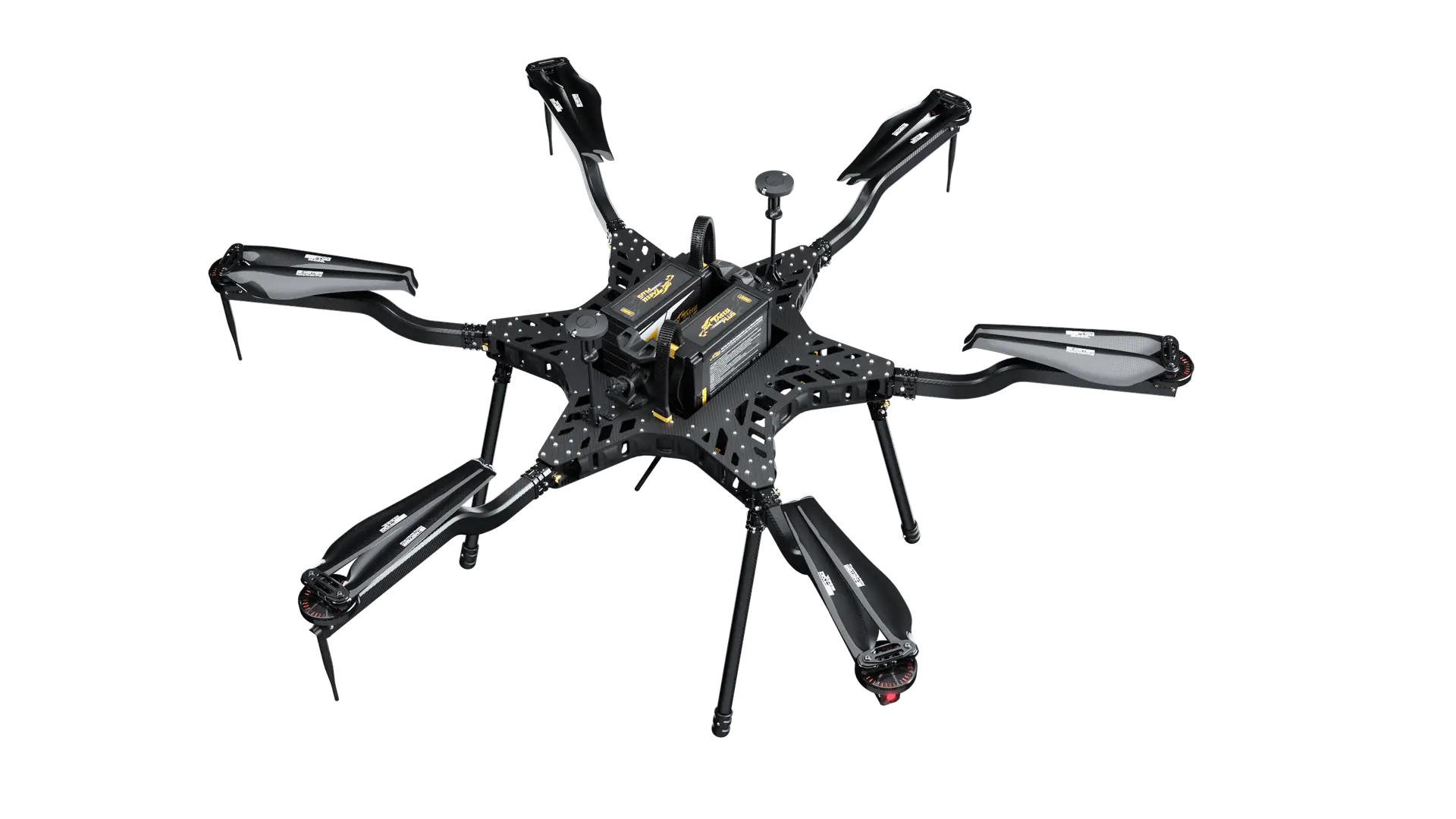
The battery platform of the three. Two smart 12S 16,000 mAh packs sit in a patent-pending rack that swaps on quick-release plungers, so a crew keeps flying through a shift on charged racks. At 18.1 kg empty against a 25 kg maximum takeoff weight, most of the lift goes to the payload, and the airframe folds into a 903 by 903 by 498 mm case and deploys in under two minutes.
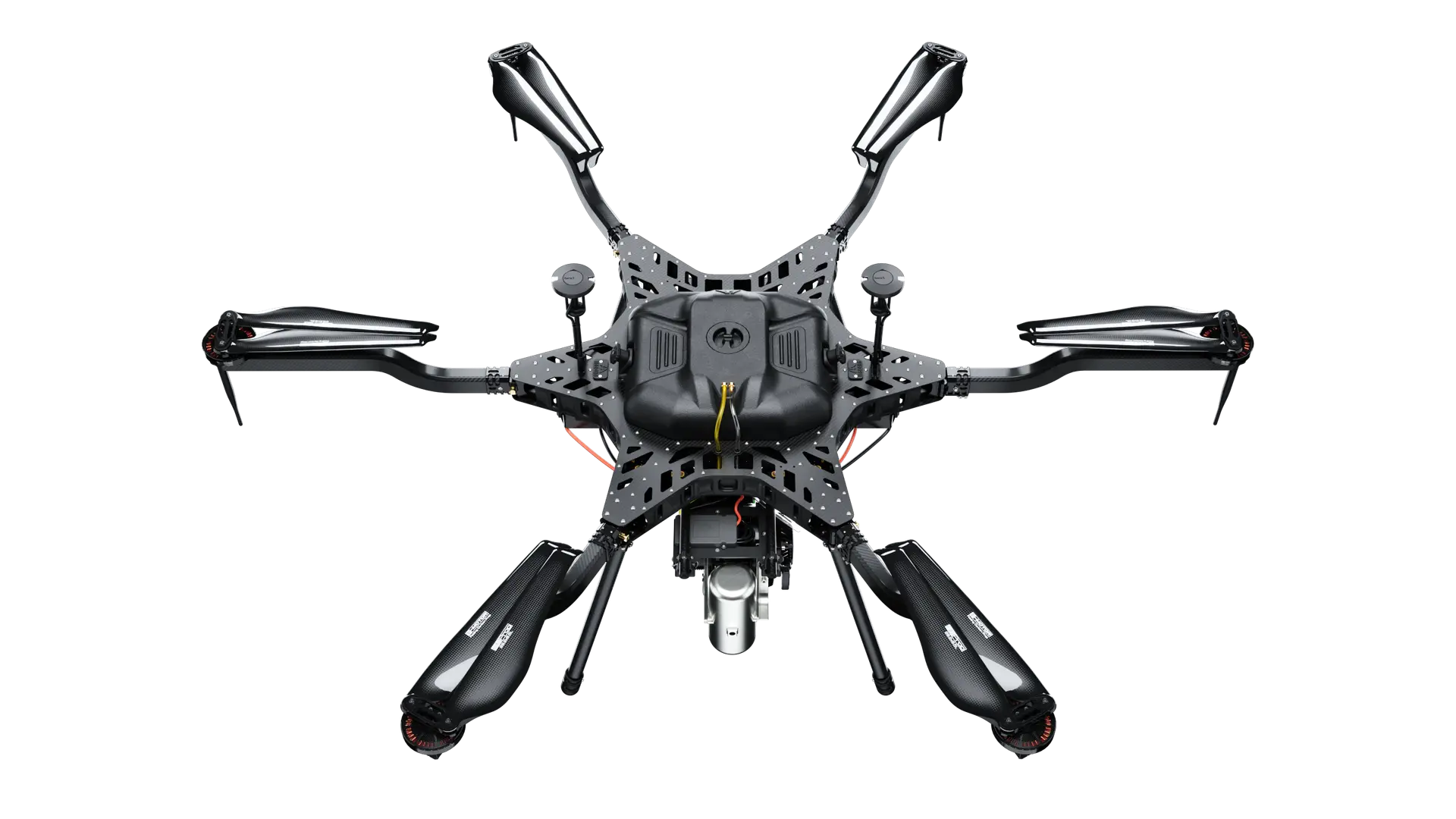
The endurance platform. An H2400 electronic-fuel-injection generator delivers 2.4 kW of continuous power from unleaded 93 octane in a 6.5 L tank, and two 6S 4,750 mAh backup packs hold five minutes of reserve if the generator stops. Refuelling takes about as long as a battery swap, and the aircraft has flown 77 miles non-stop on a demonstration flight. Empty weight is 16.3 kg without fuel.

The heavy-lift platform. Six 40-inch carbon-fiber propellers produce over 300 lb of available thrust, eight 6S 30,000 mAh packs on a slide-rail tray give 120,000 mAh at 12S, and the patented airframe folds from a 10.4-foot deployed span into a 46 by 46 inch case. The radio link reaches 12.5 miles, with an extended-range option, and maximum takeoff weight is 95 kg.
Our foldable quad is NDAA Section 848 compliant, pre-orders are open from a $24,999 base package, and the first production run is scheduled for the end of Q1 2027. It isn’t on the Blue UAS Cleared List, and we don’t describe it as Blue UAS. If your solicitation requires clearance, quote one of the three platforms above; if it requires Section 848 compliance only, the H4C Quad qualifies.
Pick by payload first, then by how long each sortie has to last. The H6 Electric and H6 Hybrid EFI share an airframe, a 25 kg maximum takeoff weight and a 2,373 mm deployed span; the H6HL is a different class of aircraft at 95 kg. Each row links to the product page where the full specification and the brochure PDF live.
| Platform | Max payload | No payload | Loaded | MTOW / empty | Power | Ceiling |
|---|---|---|---|---|---|---|
| Carrier H6 ElectricOn the Cleared List | 8 kg 17.6 lb | 48 min | ~38 min at 4 kg | 25 kg 18.1 kg empty | 2× 12S 16,000 mAh LiPo 32,000 mAh, quick-swap rack | 12,000 ft AMSL |
| Carrier H6 Hybrid EFIOn the Cleared List | 5 kg 11 lb | 240 min | ~185 min at 2 kg | 25 kg 16.3 kg empty, no fuel | H2400 EFI generator 2.4 kW, 6.5 L unleaded 93 | 6,562 ft 2,000 m AMSL |
| Carrier H6HLOn the Cleared List | 40 kg 88.2 lb | 48 min | ~30 min at 20 kg | 95 kg 55 kg empty | 8× 6S 30,000 mAh LiPo 120,000 mAh at 12S, slide-rail tray | 12,000 ft 3,658 m AMSL |
Sources: the specification and performance data on each linked product page. All three were tested at 120 m AGL with a two-minute landing reserve; the H6 Electric also at 20 °C with no wind. Payload includes sensor and mounting hardware. Our H6 Electric page lists roughly 15% less flight time at its 12,000 ft ceiling. The Hybrid EFI tank was tested at 4 L with the full 5 kg payload. Every platform here is rated IP43 and −20 to 49 °C, with a 15 m/s maximum horizontal speed.
The H6HL bars are grey because its payload points, 20 and 40 kg, are a different scale from the 2 to 8 kg points on the other two; read it as a lift platform, not an endurance platform.
Solicitations use the three terms as if they were interchangeable. They aren’t, and a vendor who blurs them is telling you something. Here is what each one does and does not establish, with our own aircraft as the worked example.
The practical order is this: Section 848 compliance gets an aircraft considered, Blue UAS clearance gets it bought by DoD without an exception, and Made in USA tells you who to call when a part is needed. When a solicitation asks for all three, the three platforms above are the only aircraft we quote against it.
This is how a Harris purchase runs for a DoD, federal or public-safety buyer, stated plainly so your contracting officer gets what they need on the first pass. Send the mission, the payload and the listing you are buying against. Our engineering team replies with a platform recommendation and a budgetary quotation on a branded PDF you can forward internally.
The quote carries the ready-to-fly aircraft, the ground control station and operator training as separate lines, names the Blue UAS configuration where it applies, and lists the payload integration on its own line when a sensor is part of the order. Each product page carries a brochure PDF with the full specification: H6 Electric, H6 Hybrid EFI and H6HL.

Three: the Carrier H6 Electric, the Carrier H6 Hybrid EFI and the Carrier H6HL. The Carrier HX8 and the H4C Quad are NDAA Section 848 compliant but are not on the Blue UAS Cleared List. Search Harris Aerial on the Blue UAS portal to see the listing for yourself.
No. NDAA Section 848 compliance is the manufacturer’s declaration that the aircraft carries no covered-country flight controller, radio, data link, camera, gimbal, ground control software or data storage. Blue UAS clearance is a DoD evaluation of a specific aircraft, including its cybersecurity, that puts it on a public list. Every Blue UAS aircraft is NDAA compliant; most NDAA-compliant aircraft aren’t Blue UAS.
Open the Blue UAS portal, search the manufacturer name and read the model exactly as listed. For our aircraft, search Harris Aerial and look for the Carrier H6 Electric, Carrier H6 Hybrid EFI and Carrier H6HL. Then send us the listing you are buying against so the quote names the same configuration.
No. The H4C Quad is NDAA Section 848 compliant, pre-orders are open from a $24,999 base package, and the first production run is scheduled for the end of Q1 2027. It is not on the Blue UAS Cleared List. A solicitation that requires Blue UAS clearance is answered with the H6 Electric, H6 Hybrid EFI or H6HL.
Yes. The list is public and any buyer can purchase an aircraft on it. DoD units get the specific benefit of buying without an exception to policy; other agencies use the list because their own procurement rules or grant conditions reference it, or because it is the shortest path to an aircraft that has already been vetted for them.
The Cleared List covers the aircraft. Payloads and components are handled separately, through the Blue UAS Framework and each sensor maker’s own compliance statement. If your solicitation requires a compliant payload, tell us in the request and we quote a matching sensor from the payload library alongside the aircraft.
Each cleared platform lists the C-GCS, C-NAV, C-SRoC and HereLink as compatible ground control stations, and the C-Navigator is NDAA Section 848 compliant. Tell us what the solicitation requires and the ground station is quoted to match, on its own line.
From the performance data on each product page: the H6 Electric flies about 38 minutes at 4 kg and 29 at its full 8 kg; the H6 Hybrid EFI about 185 minutes at 2 kg and 100 at its full 5 kg; the H6HL about 30 minutes at 20 kg and 15 at its full 40 kg. All three were tested at 120 m AGL with a two-minute landing reserve, and payload includes the mounting hardware.
Send the mission, the payload and the solicitation language, and our engineering team replies with a platform recommendation and a budgetary quotation on a branded PDF you can forward to contracting. If you’d rather talk it through first, call (407) 725-7886.

USA-made heavy-lift drones built for the missions that cannot fail. Talk to our defense sales team about your next Blue UAS procurement.

USA-made drones — engineered for the missions where reliability is non-negotiable.